Reading the Original Manuscript: Notes on al-Jazari’s Arabic Text
Insights into the language, terminology, and manuscript traditions of The Book of Knowledge of Ingenious Mechanical Devices
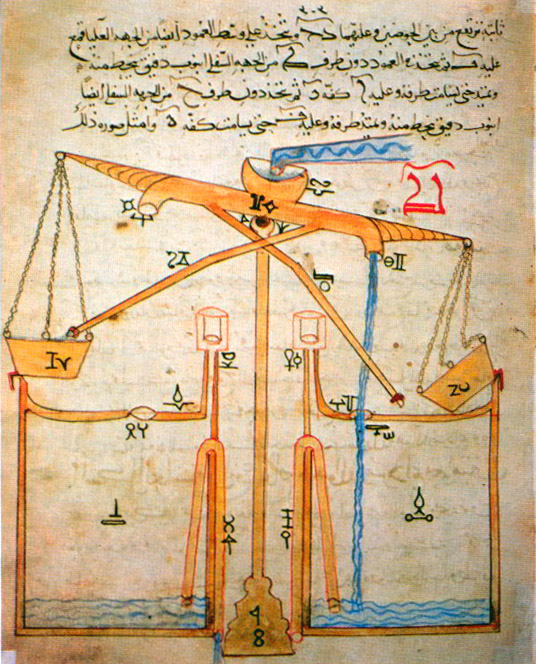
Introduction
Ismail al-Jazari’s masterpiece, completed in January 1206 and dedicated to the Artuqid ruler Nasir al-Din, survives in several beautifully illustrated manuscripts. The most famous copies are held in the Topkapı Palace Museum (Istanbul), the British Library, and the Museum of Fine Arts in Boston. Reading the original Arabic text reveals a level of technical precision and linguistic clarity that complements the celebrated diagrams.
Language and Style
Al-Jazari wrote in clear, accessible Classical Arabic with relatively little rhetorical flourish. His prose is practical and instructional — typical of technical treatises of the period. He frequently uses the first person (“I made…”, “I constructed…”) and addresses the reader directly, creating a sense of a master engineer speaking to apprentices or colleagues.
Technical terms are remarkably consistent and often accompanied by explanations, showing his awareness that future readers might not share his workshop vocabulary.
Notable Terminology
Some key Arabic terms that appear throughout the book:
- Āla (آلة) – “device” or “machine” (used for the overall contraption)
- Ḥiyal (حيل) – “ingenious devices” or “mechanical tricks” (the plural form in the book’s title)
- Dawrān (دوران) – rotation / continuous turning
- Miḥwar (محور) – axle or shaft
- ʿAmūd (عمود) – connecting rod or upright lever
- Ṣundūq (صندوق) – box or casing (often housing gears or floats)
“ثمّ أعملتُ في داخل الفيل صندوقاً من نحاس…”
“Then I made inside the elephant a copper box…”
Manuscript Traditions
The surviving manuscripts fall into two main families:
- Early copies (13th–14th century) — closest to the original, with finer illustrations and more accurate technical details.
- Later Ottoman copies — often more decorative but sometimes with simplified or altered mechanisms.
The most studied version is the 1315 copy (AH 715) now in the Topkapı Palace (Ahmet III 3472). Its illustrations are exceptionally clear, and the text is remarkably well preserved. Scholars such as Donald R. Hill and the late Eilhard Wiedemann relied heavily on this manuscript for their translations and analyses.
Challenges in Reading the Text Today
Modern readers encounter several hurdles:
- Technical vocabulary that is sometimes unique to al-Jazari or his workshop.
- Occasional ambiguities in the description of moving parts (the diagrams usually resolve these).
- Differences between manuscripts — scribes occasionally misread numbers or omitted small details.
Fortunately, the combination of text and high-quality diagrams makes al-Jazari’s intentions remarkably recoverable even after eight centuries.
Why the Original Arabic Matters
Reading the Arabic reveals nuances that translations sometimes flatten. Al-Jazari’s careful choice of words shows deep understanding of materials, tolerances, and practical construction. His frequent use of “I tested…” or “I adjusted until it worked perfectly…” gives us a rare glimpse into the iterative process of medieval engineering — trial, error, and refinement.
It also reminds us that the Islamic Golden Age produced not only theoretical science but also a rich tradition of hands-on, experimental engineering literature.